
การรับรู้และความคาดหวังของพยาบาลต่อบทบาทหน้าที่ของเภสัชกรประจำหอผู้ป่วยในประเทศไทย: การวิจัยเชิงสำรวจระดับประเทศ
คำสำคัญ:
ความคาดหวัง, พยาบาล, การรับรู้, เภสัชกร, เภสัชกรประจำหอผู้ป่วยบทคัดย่อ
ความเป็นมา: เภสัชกรประจำหอผู้ป่วยเป็นหนึ่งในทีมสหวิชาชีพทางการแพทย์ซึ่งจำเป็นต้องทำงานร่วมกับพยาบาล จึงจำเป็นต้องศึกษาการรับรู้และความคาดหวังของพยาบาลต่อการทำงานร่วมกับเภสัชกรประจำหอผู้ป่วย เพื่อเป็นแนวทางในการพัฒนาบทบาทของเภสัชกรประจำหอผู้ป่วยให้ชัดเจนมากขึ้น
วัตถุประสงค์: เพื่อศึกษาการรับรู้และความคาดหวังของพยาบาลที่มีต่อบทบาทหน้าที่เภสัชกรประจำหอผู้ป่วยในประเทศไทย
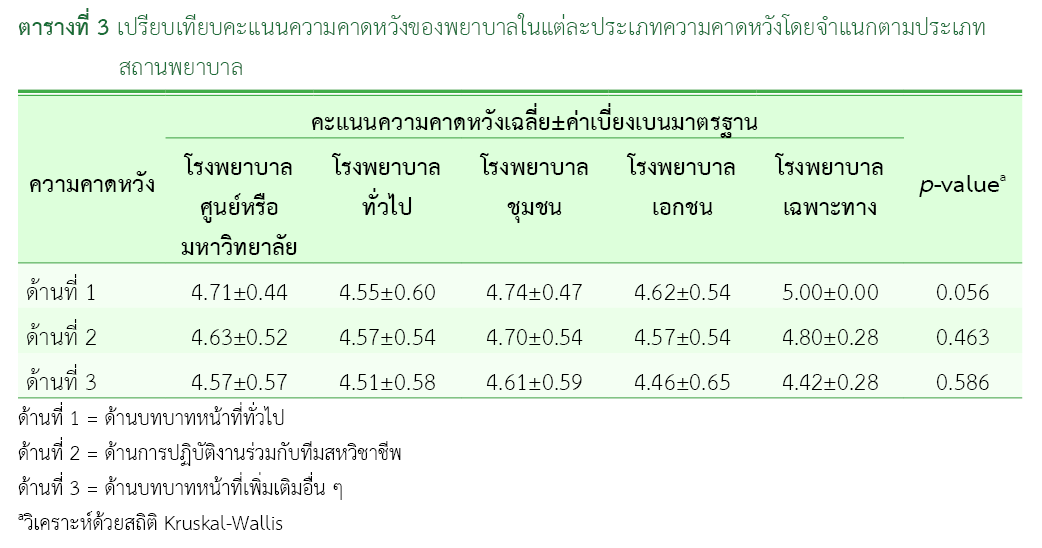
วิธีวิจัย: การศึกษาเชิงสำรวจแบบภาคตัดขวาง โดยเก็บข้อมูลจากพยาบาลวิชาชีพที่ปฏิบัติงานอยู่ในโรงพยาบาล ผ่านแบบสอบถามออนไลน์ที่ประกอบด้วยคำถามปลายปิด และคำถามปลายเปิด โดยข้อมูลทั่วไปของผู้ตอบแบบสอบถามรายงานเป็นความถี่และร้อยละ ความสัมพันธ์ระหว่างข้อมูลทั่วไปของผู้ตอบแบบสอบถามกับการรับรู้บทบาทหน้าที่ของเภสัชกรประจำหอผู้ป่วยใช้การทดสอบ chi-square หรือ Fisher’s exact ส่วนความคาดหวังวัดโดยแบ่งระดับความคาดหวังออกเป็น 5 ระดับตามมาตรวัด Likert คะแนนเฉลี่ยของความคาดหวังในแต่ละประเภทใช้ค่าเฉลี่ยเลขคณิตและค่าเบี่ยงเบนมาตรฐาน และการเปรียบเทียบคะแนนความคาดหวังในแต่ละด้านโดยจำแนกตามประเภทสถานพยาบาลใช้การทดสอบ Kruskal-Wallis โดยกำหนดระดับนัยสำคัญทางสถิติที่ 0.05
ผลการวิจัย: กลุ่มตัวอย่าง 461 คน บทบาทของเภสัชกรประจำหอผู้ป่วยที่มีการรับรู้มากที่สุด คือ การประเมินอาการไม่พึงประสงค์จากการใช้ยาของผู้ป่วย (ร้อยละ 88.1) ส่วนบทบาทของเภสัชกรประจำหอผู้ป่วยที่พยาบาลความหวังมากที่สุด ได้แก่ สามารถให้ความรู้ และแนะนำเกี่ยวกับการใช้ยา รวมทั้งการปฏิบัติตัวที่เหมาะสมกับโรคของผู้ป่วยขณะนอนรักษาตัวอยู่บนหอผู้ป่วยและก่อนถูกจำหน่ายออกจากโรงพยาบาล โดยมีระดับความคาดหวังมากที่สุดร้อยละ 72.7 อีกทั้งพยาบาลส่วนใหญ่ต้องการให้มีเภสัชกรประจำหอผู้ป่วยในโรงพยาบาล
สรุปผล: พยาบาลส่วนใหญ่มีการรับรู้บทบาทหน้าที่เภสัชกรประจำหอผู้ป่วยและความคาดหวังต่อบทบาทหน้าที่เภสัชกรประจำหอผู้ป่วยระดับคาดหวังมากที่สุดในบทบาททุกด้าน และมีความต้องการให้มีเภสัชกรประจำหอผู้ป่วยในโรงพยาบาล
เอกสารอ้างอิง
Bryant R, Chaar B, Schneider C. Differing clinical pharmacy service models: quantitative and qualitative analysis of nurse perceptions of support from pharmacists. Int J Nurs Stud. 2018;86:90-8. doi: 10.1016/j.ijnurstu.2018.04.003.
Kaboli PJ, Hoth AB, McClimon BJ, Schnipper JL. Clinical pharmacists and inpatient medical care: a systematic review. Arch Intern Med. 2006;166(9):955-64. doi: 10.1001/archinte.166.9.955.
Waszyk-Nowaczyk M, Guzenda W, Dragun P, Olsztyńska L, Liwarska J, Michalak M, et al. Interdisciplinary cooperation between pharmacists and nurses – experiences and expectations. Int J Environ Res Public Health. 2022;19(18):11713. doi: 10.3390/ijerph191811713.
Lindsay PH, Norman DA. Human information processing: an introduction to psychology. 2nd ed. New York: Academic Press; 2013.
Olson JM, Roese NJ, Zanna MP. Expectancies. In: Social psychology: handbook of basic principles. New York: The Guilford Press; 1996. p. 211-38.
Vroom VH. Management and motivation. London: Penguin Books; 1970.
Gillespie U, Mörlin C, Hammarlund-Udenaes M, Hedström M. Perceived value of ward-based pharmacists from the perspective of physicians and nurses. Int J Clin Pharm. 2012;34(1):127-35. doi: 10.1007/s11096-011-9603-1.
Sjölander M, Gustafsson M, Gallego G. Doctors’ and nurses’ perceptions of a ward-based pharmacist in rural northern Sweden. Int J Clin Pharm. 2017;39(4):953–9. doi: 10.1007/s11096-017-0488-5.
Shanika LG, Wijekoon CN, Jayamanne S, Coombes J, Coombes I, Mamunuwa N, et al. Acceptance and attitudes of healthcare staff towards the introduction of clinical pharmacy service: a descriptive cross-sectional study from a tertiary care hospital in Sri Lanka. BMC Health Serv Res. 2017;17(1):46. doi: 10.1186/s12913-017-2001-1.
ศหัสญา ธูปบูชา. การบริบาลเภสัชกรรมบนหอผู้ป่วยอายุรกรรมชาย และอายุรกรรมหญิง ตึกกาญจนาภิเษก โรงพยาบาลพหลพลพยุหเสนา [อินเทอร์เน็ต]. กาญจนบุรี: สำนักงานสาธารณสุขจังหวัดกาญจนบุรี; 2563 [สืบค้นเมื่อ 1 ก.ค. 2566]. หน้า 11–13. สืบค้นจาก: https://www.kanpho.go.th/new/images/downloads/เล่ม_3_เนื้อหาผลการดำเนินงานที่ผ่านมา.pdf
วรนุช แสงเจริญ, สงวน ลือเกียรติบัณฑิต, ขวัญตา ณ ถลาง, ทิตตาภา พรหมเพชร, กุลภัสสร์ แซ่เอง, รัศมี ชาติดำรงค์, และคณะ. ทัศนคติของบุคลากรทางการแพทย์ในภาคใต้ต่อบทบาทของเภสัชกรในทีมให้การรักษาผู้ป่วยใน. วารสารไทยเภสัชสาร. 2544;25(3):109-20. doi: 10.56808/3027-7922.2310.
สำนักงานปลัดกระทรวงสาธารณสุข. กองยุทธศาสตร์และแผนงาน. รายงานทรัพยากรสาธารณสุข ประจำปี 2565 [อินเทอร์เน็ต]. นนทบุรี: กองยุทธศาสตร์และแผนงาน สำนักงานปลัดกระทรวงสาธารณสุข; 2565 [สืบค้นเมื่อ 1 ก.ค. 2566]. สืบค้นจาก: https://spd.moph.go.th/wp-content/uploads/2023/07/Report-Health-Resource-65.pdf
Krejcie RV, Morgan DW. Determining sample size for research activities. Educ Psychol Meas. 1970;30(3):607-10. doi: 10.1177/001316447003000308.
Jongkraijakra S, Pannoi T, Wongsiripolkul K, Aengchuan K, Saisap P. A survey of perceptions and expectations of hospital pharmacists to the roles of ward-based pharmacists in Thailand. Thai J Pharm Sci. 2024;48(2):e2. doi: 10.56808/3027-7922.2906.
สมาคมเภสัชกรรมโรงพยาบาล (ประเทศไทย). มาตรฐานวิชาชีพเภสัชกรรมโรงพยาบาล พ.ศ. 2566–2572 [อินเทอร์เน็ต]. กรุงเทพมหานคร: สมาคมเภสัชกรรมโรงพยาบาล (ประเทศไทย); 2568 [สืบค้นเมื่อ 29 ส.ค. 2568]. สืบค้นจาก: https://heyzine.com/flip-book/918a88b264.html
Fewster-Thuente L, Velsor-Friedrich B. Interdisciplinary collaboration for healthcare professionals. Nurs Adm Q. 2008;32(1):40-8. doi: 10.1097/01.NAQ.0000305946.31193.61.
Hatton K, Bhattacharya D, Scott S, Wright D. Barriers and facilitators to pharmacists integrating into the ward-based multidisciplinary team: a systematic review and meta-synthesis. Res Social Adm Pharm. 2021;17(11):1923-36. doi: 10.1016/j.sapharm.2021.02.006.
พัชรี มณีไพโรจน์, ปิยลักษณ์ โพธิวรรณ. สิทธิในการได้รับสวัสดิการด้านบริการสาธารณสุขของรัฐไทย. วารสารวิจัยและพัฒนาระบบสุขภาพ [อินเทอร์เน็ต]. 2563 [สืบค้นเมื่อ 29 ส.ค. 2568];13(1):300–9. สืบค้นจาก: https://he02.tci-thaijo.org/index.php/RDHSJ/article/view/254848
Azhar S, Hassali MA, Mohamed Ibrahim MI, Saleem F, Siow Yen L. A survey evaluating nurses’ perception and expectations towards the role of pharmacist in Pakistan’s healthcare system. J Adv Nurs. 2012;68(1):199-205. doi: 10.1111/j.1365-2648.2011.05728.x.
Nakahara R. The ideal role of pharmacists: a nurse's perspective. Yakugaku Zasshi. 2020;140(3):415-8. doi: 10.1248/yakushi.19-00194-3.
จินดา ปิยะสิริวัฒน์. บทบาทของเภสัชกรบนหอผู้ป่วย ที่โรงพยาบาลพิจิตร [วิทยานิพนธ์เภสัชศาสตรมหาบัณฑิต]. กรุงเทพมหานคร: คณะเภสัชศาสตร์ จุฬาลงกรณ์มหาวิทยาลัย; 2539. doi: 10.58837/CHULA.THE.1996.45.
ดาวน์โหลด
เผยแพร่แล้ว
วิธีการอ้างอิง
ฉบับ
บท
การอนุญาต
ลิขสิทธิ์ (c) 2026 กองบริหารการสาธารณสุข สำนักงานปลัดกระทรวงสาธารณสุข และ ชมรมเภสัชกรโรงพยาบาลกระทรวงสาธารณสุข

This work is licensed under a Creative Commons Attribution-NonCommercial-NoDerivatives 4.0 International License.
วารสารเภสัชกรรมคลินิกเป็นวารสารในรูปแบบเปิด ผู้ใช้ทั่วไปสามารถเข้าถึง ดาวน์โหลด เอกสารไฟล์บทความบนเว็บไซต์วารสาร โดยไม่มีค่าใช้จ่ายแต่อย่างใด
ข้อความภายในบทความที่ตีพิมพ์ในวารสารเภสัชกรรมคลินิกทั้งหมด รวมถึงรูปภาพประกอบ ตาราง เป็นลิขสิทธิ์ของกองบริหารการสาธารณสุข สำนักงานปลัดกระทรวงสาธารณสุข และ ชมรมเภสัชกรโรงพยาบาลกระทรวงสาธารณสุข อนุญาตให้นำไปใช้ประโยชน์และเผยแพร่ต่อได้โดยอยู่ภายใต้เงื่อนไขสัญญาอนุญาตครีเอทีฟคอมมอนส์ โดยต้องแสดงที่มาจากวารสาร – ไม่ใช้เพื่อการค้า – ห้ามแก้ไขดัดแปลง (Creative Commons Attribution-NonCommercial-NoDerivatives 4.0; CC BY-NC-ND 4.0) การนำเนื้อหา ข้อความหรือข้อคิดเห็น รูปภาพ ตาราง ของบทความไปจัดพิมพ์เผยแพร่ในรูปแบบต่าง ๆ เพื่อใช้ประโยชน์ในเชิงพาณิชย์ ต้องได้รับอนุญาตจากกองบรรณาธิการวารสารเภสัชกรรมคลินิกอย่างเป็นลายลักษณ์อักษร
ข้อความที่ปรากฏในบทความในวารสารเป็นความคิดเห็นส่วนตัวของผู้เขียนแต่ละท่านไม่เกี่ยวข้องกับกองบริหารการสาธารณสุข สำนักงานปลัดกระทรวงสาธารณสุข และบุคลากรในกองบริหารการสาธารณสุข สำนักงานปลัดกระทรวงสาธารณสุข แต่อย่างใด ความรับผิดชอบองค์ประกอบทั้งหมดของบทความแต่ละเรื่องเป็นของผู้เขียนแต่ละท่าน หากมีความผิดพลาดใด ๆ ผู้เขียนแต่ละท่านจะรับผิดชอบบทความของตนเอง ตลอดจนความรับผิดชอบด้านเนื้อหาและการตรวจร่างบทความเป็นของผู้เขียน ไม่เกี่ยวข้องกับกองบรรณาธิการ