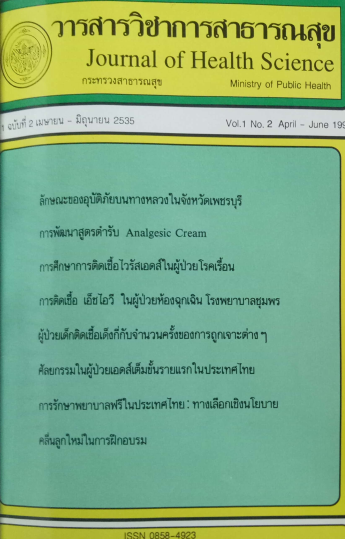
A Study on Human Immunodeficiency Virus Infection In leprosy Patients
Abstract
Sera from 790 leprosy patients were collected from Phra-PradaengHospital, Raj-Pracha-Samasai Institute and Nonsomboon Leprosarium Between June 1990 - March 1991. They were screened for anti-HIV IgG antibodies by Particle agglutination test and confirmed by Western Blot assay. The patients were also interviewed for epidemiological baseline data to fine any possible risk factors. There were 10 anti-HIV positive resulting a prevalence of 1.27%. Nine were male and 1 was female. Median age of this group was between 15-40 year with 2 over 60 years of age. Among those 10 anti-HIV seropositive patients, 5 had history of sexual relation with prostitutes within 1 year, 5 were intravenous heroin abusers, 3 received blood transfusion, 4 showed tattoos on the body or ear piercing and 1 was homosexual. Seven HIV seropositive patients were multi-bacillary leprosy patients whereas the other 3 were paucibacillary. Only 4 out of those 10 could be closely followed up and blood collected every 3 months for analysis of T4:T8 ratios and lymphoproliferative responses to mitogen (PHA) or antigens (P.P.D. or M. leprae antigen). The interim data from HIV seropositive leprosy patients showed normal T4:T8 ratios and no significant difference in lymphoproliferative response as compared to leprosy patients without HIV infection. However HIV seropositive cases in leprosy patients show significantly higher prevalence rate than those with age and sex-matched general population in Samutprakarn.
Downloads
Downloads
Published
How to Cite
Issue
Section
License
Copyright (c) 1992 Ministry of Public Health

This work is licensed under a Creative Commons Attribution-NonCommercial-NoDerivatives 4.0 International License.